
Edited by: Paul Emiljanowicz, Melissa Levin, Jesi Carson, Julien Landry, Bettina von Lieres & Chandrima Chakraborty
In 2025, we published a special issue exploring the idea and practice of democratic pedagogies, quickly learning that the number of practices, ideas, and experiences demanded a larger edited volume. This book will serve as a rallying point for those working to rethink how teaching and learning can cultivate the capacities, practices, and imaginaries necessary for democratic life.
Education systems have been central to the reproduction of unjust political and economic systems. Scholars and universities were at the forefront of justifying monarchical and then nationalist-state expansion, producing knowledge and justifications that rationalized global slavery, colonization, and imperialism. Modern schooling systems institutionalized hierarchies of race, gender, class, and ability while claiming to prepare liberal citizens and orderly workers. At the same time, communities have developed and practiced pedagogies, both within and beyond universities, to resist and build the capacity to confront and work through collective challenges. In many cases, communities exercise their own learning infrastructures for self-governance outside the classroom, whether via religious institutions, local associations, unions, social movements, and nonprofit organizations, or invest significant effort in reshaping existing institutions to make them responsive to their needs.
Currently, our democratic institutions as well as democratic culture, values, norms, and everyday practices are being hollowed out through executive aggrandizement, declining civil liberties, the normalization of political violence, increasing inequality, environmental collapse, and protracted wars. These pressures are not distant geopolitical trends; they structure the ecosystems in which we teach, learn, research, and organize, from curricular bans and surveillance of educators, to global concerns over academic freedom. Education systems have never stood outside these dynamics. Democracy has long placed a normative value on education, and as democratic gains are being attacked, we are seeing on the one hand, the structural transformation of universities and societies carried out under the guise of depoliticization, narrowing the scope of legitimate inquiry, discouraging engagement with conflict, reaching across difference, and reframing democratic participation as risk or disorder. And on the other, a proliferation of democratic pedagogies from around the world that continue to challenge and contribute to a long history of teaching and learning that is responsive to and elicits responsibility for changing sociopolitical contexts and intertangled ‘wicked problems’.
Rather than engage the entanglement of politics with the university or create conditions for communities to work through deep disagreement, administrations have increasingly relied on ostensibly neutral frameworks for navigating conflict in the classroom. These include guidance on respectful dialogue, viewpoint diversity, and instructor neutrality, drawing on widely adopted free expression doctrines, structured dialogue models, and intercultural competency frameworks promoted across North American, European, and Asian institutions. While intended to enable difficult conversations, in practice, these doctrines frequently delimit and constrain the scope of what can be said and how disagreement can unfold. Discussions of genocide, for example, are routed through rules that prioritize neutrality, equal recognition of perspectives, and the maintenance of classroom order, even where such symmetry obscures asymmetries of power, violence, responsibility, and ongoing harm. The emphasis on civility and safety can preempt contestation, positioning strong normative claims or expressions of solidarity as risks to be managed rather than democratic contributions. As a result, these frameworks tend to organize participation without fully engaging the ethical and political stakes of the issues at hand. What emerges is a pedagogical environment that is procedurally careful but democratically thin, where the aspiration to avoid harm limits the capacity to confront ethical dilemmas, and where universities retreat from their role as sites for collective reasoning and normative positioning about the most difficult questions of our time.
In contrast, effective democratic pedagogy brings people together and develops capacity for collective self-governance and action to address complex problems and ethical dilemmas for diverse populations. Democratic pedagogies operate as a mode of democratic design that redistributes power, confronts epistemic injustice, and makes participation a lived practice. These pedagogies intentionally organize educational spaces as sites of shared self-governance, where participants collectively shape the goals, processes, and outcomes of learning. They confront systems of domination by foregrounding anti-oppressive, anti-racist, feminist, and decolonial commitments while recognizing the intersectional power relations that structure knowledge, participation, and authority. They further cultivate plural, relational, and community-engaged forms of learning that expand beyond the classroom, fostering critical inquiry, experimentation, creativity, co-design, as well as a collective capacity to imagine and the skills to concretely build more just democratic futures. By treating learning as embedded in struggle, co-governance, and institutional transformation, democratic pedagogies illuminate how democracy is enacted, contested, and reimagined across a plurality of contexts. In doing so, they offer not only a critique of domination and exclusion, but a forward-looking framework for cultivating more just, inclusive, resilient, and genuinely democratic forms of collective life. Democratic pedagogies are not just classroom techniques but praxis that cultivate power and capacities of relational agency, for action.
This edited volume seeks to advance the idea and practice of democratic pedagogies for democratic futures, expanding from our special issue to explore more deeply the experiences, potentials, lessons, and impacts of democratic pedagogies, from around the world, both inside and outside of the ‘classroom’. We are particularly interested in contributions that engage with the emerging idea of democratic pedagogies through their own experiences (co)designing or facilitating pedagogy, in relation, but not limited to, one of the sections or questions below. We are open to contributions that examine the impacts of democratic pedagogies across multiple levels and domains, including interpersonal and relational dynamics, with/in communities, workplaces, classrooms, and applications in areas such as politics, economics, governance, workplaces and civic life. We also welcome reflections on individual level effects, including personal transformation, emotional experience, wellbeing, confidence, and agency, as well as broader institutional, collective, and societal implications. Contributions may draw on empirical research, reflective practice, conceptual development, or applied case studies, and may address impacts that unfold during pedagogical processes as well as those that emerge over time across professional, civic, and everyday contexts.
Suggested Thematic Sections and Guiding Questions for Contributors
Democratic Pedagogies in formal University Settings
What are democratic pedagogies and how are they designed, facilitated, and experienced in formal learning environments such as the university? We welcome empirically grounded accounts of pedagogical practices and impacts from classrooms, University-community spaces, and hybrid settings.
What pedagogical methods, technologies, approaches, or institutional arrangements redistribute power in learning processes?
How are participation, deliberation, or collective decision-making embedded in teaching practice?
What tensions emerge between democratic pedagogy and existing institutional constraints?
What evidence exists of learning outcomes, civic capacities, or collective agency produced through these practices - what ‘actions’ took place?
Democratic Pedagogies beyond the ‘Classroom’
Many democratic pedagogies emerge outside formal educational institutions, whether in civic programming, community or nongovernmental organizations, in religious institutions and neighbor convenings, among many others. This section explores learning practices developed in communities, social movements, and civil society organizations.
How have communities created their own learning infrastructures for self-governance and collective action?
What pedagogical traditions have emerged from social movements, Indigenous communities, faith institutions, or grassroots organizations?
How do these practices challenge or transform dominant educational models?
What lessons can formal education institutions learn from community-based pedagogies?
Transformation through Democratic Pedagogies
Democratic pedagogies do not only reshape learning processes, they can also generate interpersonal, institutional, and societal impacts. This section explores how democratic pedagogies contribute to anti-oppression, decolonization, civic capacity building, and transformations in relationships, knowledge production, interpersonal and collective action across different domains.
How do democratic pedagogies contribute to anti-oppression, decolonization, or the redistribution of voice, authority, and knowledge across educational, civic, or workplace contexts?
What interpersonal, relational, or individual impacts emerge from democratic pedagogies, including changes in trust, solidarity, agency, emotional wellbeing, or collective capacity for action?
How do democratic pedagogies shape civic, political, or economic participation, and what longer-term institutional or community transformations can be traced to these practices?
How does enacting democratic pedagogies put educators and practitioners at risk?
Democratic Pedagogies for Democratic Futures
This section invites forward-looking contributions that examine how democratic pedagogies bring people together to address shared challenges and develop collective normative responses to issues such as climate change, reparations, decolonization, and democratic renewal. We welcome work that explores how pedagogical processes convene diverse participants, support collaboration across difference, promote self-governance, and generate shared problem framing, proposals, and action across civic, institutional, and community contexts.
How can democratic pedagogy contribute to renewing democratic institutions, cultures, and forms of public problem solving?
What capacities for collective problem solving, civic imagination, codesign, or democratic agency can pedagogy cultivate in response to specific societal challenges?
How might democratic pedagogies convene diverse groups to work through polarization, conflict, or competing interests around issues such as technological change, inequality, or climate crisis?
What new or emerging models of education and learning are enabling collaborative responses to complex public problems?
How to Submit
We welcome contributions that are related to democratic pedagogies, in theory, practice, and impact, but do not necessarily ‘fit within’ the above-mentioned prompts.
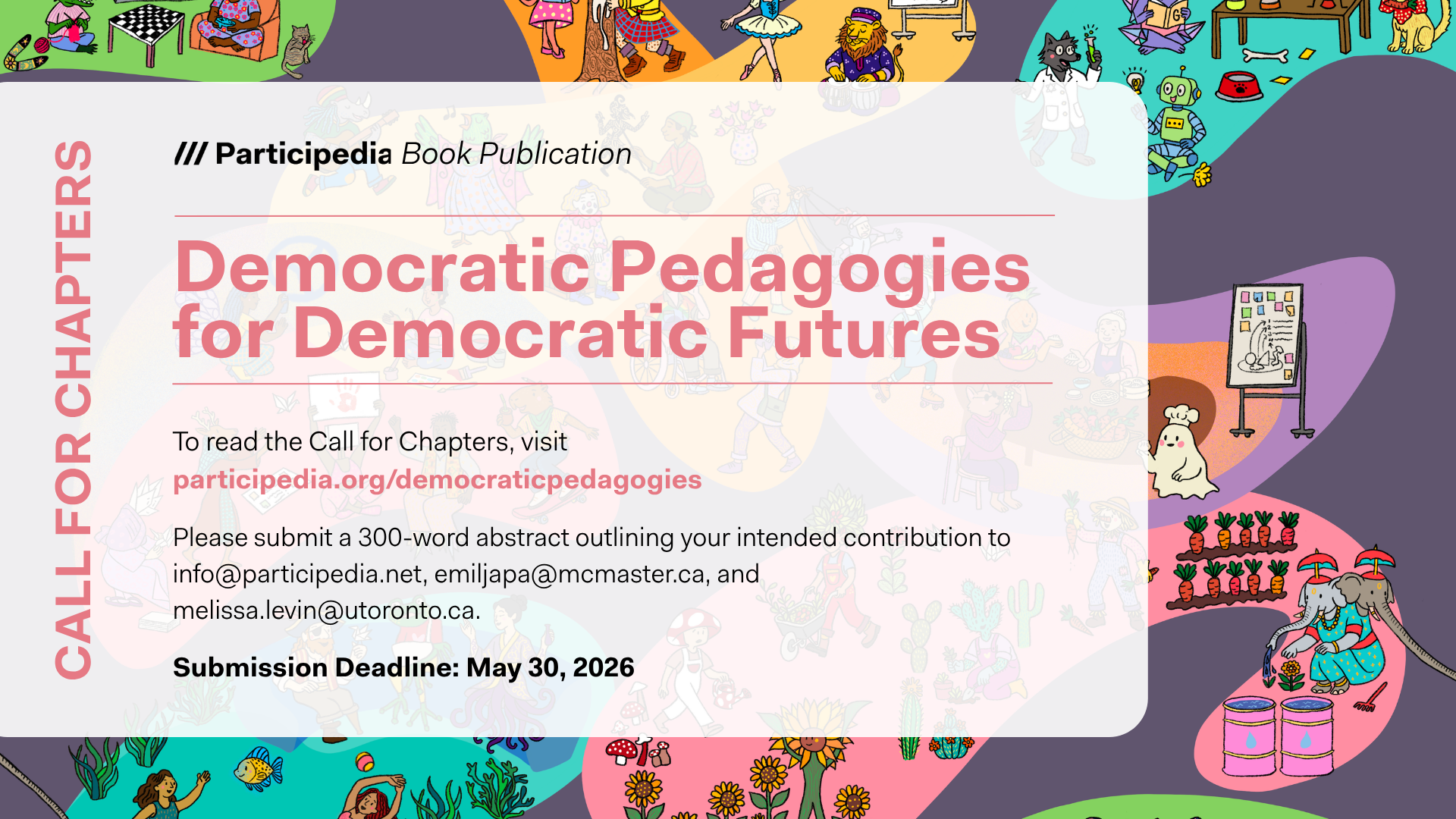
Please submit a 300 word abstract, outlining your intended contribution and how it fits within the above proposed themes, to info@participedia.net, emiljapa@mcmaster.ca, and melissa.levin@utoronto.ca by May 30, 2026. Accepted contributors will be expected to participate in a virtual workshop to help cohere the volume. We will respond to all submissions by June 30, 2026.